
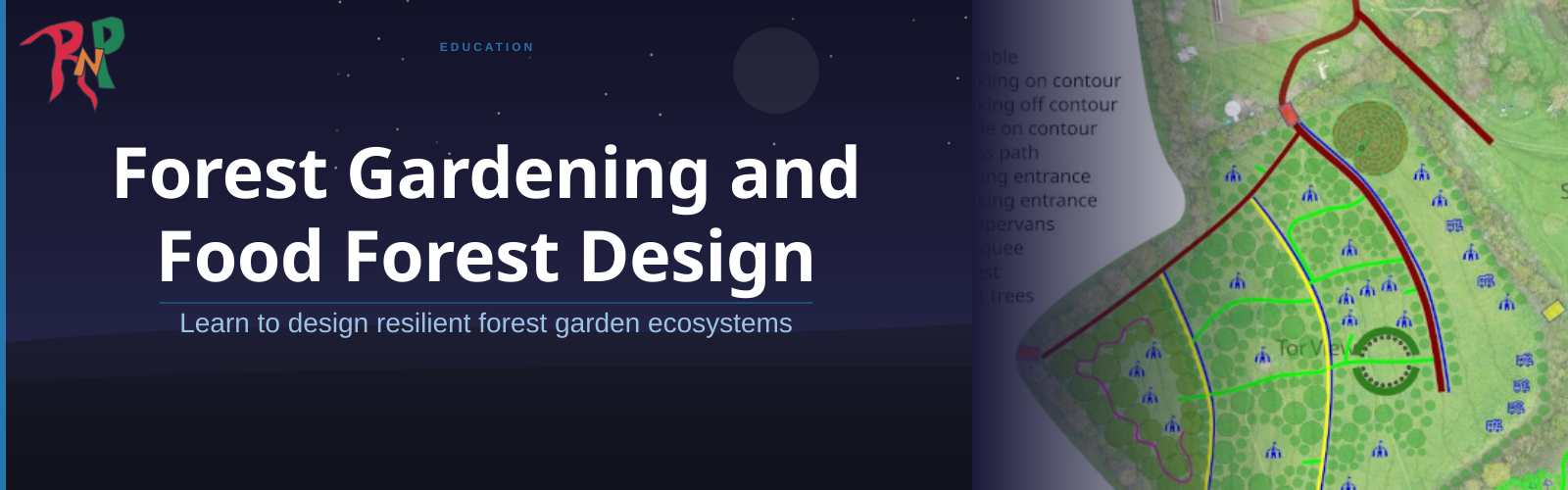
Forest gardening is a way of growing food and useful plants by learning from how woodland ecosystems function. Instead of single crops grown in rows, a forest garden brings together trees, shrubs, herbs and ground plants that share space in different layers and support each other over time.
These systems can produce fruit, nuts, vegetables, herbs, medicines and fibres while also creating habitat for wildlife. As they mature, they can build soil, improve water cycles and develop into resilient landscapes that continue to evolve.
Forest gardening is not about copying a forest exactly. It is about understanding patterns in nature and applying those patterns to create productive systems suited to local climates, landscapes and communities.
What is a Forest Garden?
A forest garden is usually structured in layers similar to those found in woodland ecosystems. These can include canopy trees, smaller fruit trees, shrubs, herbaceous plants, ground covers, climbers and root crops.
Each layer contributes different functions. Some plants produce food, others build soil fertility, provide mulch, attract pollinators or offer shade and protection. When these relationships are understood, the system can gradually become more stable and productive.
The aim is not simply production. A well designed forest garden can also create diverse living landscapes that support both people and wildlife.
Forest Gardening, Food Forests and Agroforestry
Several related terms are often used when talking about growing food with trees. They overlap, but each highlights a slightly different aspect.
Forest gardening usually refers to the practice of designing and managing diverse, multi layered systems inspired by woodland ecosystems.
A food forest is often used to describe the system that results, where trees, shrubs, herbs and other plants grow together to produce food and useful yields.
Agroforestry is the wider field of integrating trees with agriculture, often at farm or landscape scale. Examples include alley cropping, silvopasture and other farming systems that combine trees with crops or livestock.
In practice these ideas overlap. Forest gardens can be seen as a small scale form of agroforestry that focuses strongly on ecological relationships and long term landscape health.
Temperate and Tropical Forest Gardens
Forest gardening principles can be applied in many climates, but the systems themselves can look very different depending on where they are located.
In temperate regions, forest gardens often focus on fruit trees, berries, perennial vegetables, herbs and useful shrubs. Seasonal changes, winter dormancy and slower growth patterns influence how these systems develop.
Tropical forest gardens can be more densely layered and productive throughout the year. They may include plants such as bananas, cassava, coconuts, cacao, spices and many other perennial crops adapted to warm climates.
Although the plant species differ, the design approach remains similar. By observing patterns such as sunlight, water, soil and plant relationships, it becomes possible to design systems that work with the conditions of a particular place.
Learning Forest Gardening with Roots n Permaculture
Roots n Permaculture offers forest gardening courses that explore how woodland inspired systems can be designed and developed over time.
Most courses focus on temperate climate forest gardens, as many of the learning opportunities take place in regions where these conditions apply.
The teaching approach encourages participants to observe landscapes, understand ecological relationships and develop their own design thinking so they can adapt these ideas to different environments.
Introduction to Forest Gardening (1 or 2 Days)
These short courses introduce the principles behind forest gardening and food forest design. Participants explore plant layers, ecological relationships and examples of forest garden systems.
The aim is to help people understand how these systems function and how the ideas might be applied in their own gardens, farms or community projects.
Advanced Forest Garden Design Course (3 Days)
The three day advanced course focuses on the design process in more depth. Participants have the opportunity to work through real forest garden designs and explore practical considerations for implementation.
Participants can bring their own site or project to work on, or choose to collaborate on someone else's design during the course. This creates space for discussion, shared learning and the experience of working through a full design process.
By the end of the course, participants have developed practical design experience that can support them in developing forest gardens in their own landscapes or communities.
Tropical Forest Garden Courses
While most current courses focus on temperate forest gardens, the design principles can also be applied in tropical climates.
If you are interested in forest gardening courses or training in a tropical region, please get in touch to discuss possibilities.
Experiences from Participants
People joining Roots n Permaculture courses come from many different backgrounds and regions. What connects them is an interest in learning practical ways to design regenerative systems.
Participants often share how learning about forest gardening changes the way they see landscapes and food systems. Many go on to apply these ideas in gardens, farms, community projects and educational initiatives.
You can read reflections from past participants on our feedback and testimonials page.
Explore Upcoming Courses
If you would like to learn more, you can explore upcoming learning opportunities through the courses overview.
Forest gardening is ultimately about learning to work with living systems. With observation, creativity and collaboration, these approaches can support thriving landscapes and communities.
| No events |
Upcoming Course Dates Forest Gardening
| No events |